A Better English to Greek Word Search

searchOne of the most difficult parts of trying to speak Koine Greek is finding the right ancient word. I’ve already detailed a lot of the problems with most of the currently available resources in this post on the need for a contemporary English to Greek Dictionary. In that post, I mentioned The Perseus Project’s search function at http://www.perseus.tufts.edu/hopper/definitionlookup as a quick way to find what you need, but I pointed out how unhelpful many of its features were.

perseusWell, recently Don Cobb directed me to a much better version of the same type of search. Continue reading

Posted in Links of Interest, Resources | Tagged , , , , , , | 1 Comment

Coffee in Koine Greek

I’m not really a coffee drinker. I’d love to be, as it would give me one more thing to be snobby about. But for now, I’ll stick to cufflinks and Savile Row suits. In any case, according to Wikipedia, coffee was introduced around the 15th or 16th century, so it’s fairly recent and there is, therefore, no Koine Greek word Continue reading

Posted in Word of the Week | Tagged , , | 37 Comments

Some New Koine Greek Videos

Fellow blogger Michael Halcomb has begun posting some communicative Greek κινηματογραφικά at his website Pisteuomen under the series title Νοουμεν Ελληνις (that should probably be ἑλληνιστὶ νοοῦμεν or νοοῦμεν τὰ ἑλληνικά/τὴν ἑλληνικήν). I believe Michael is freshly back Continue reading

Posted in Announcements | Tagged , , , | 5 Comments

A Post-break Post

The holiday break officially ended for me on Monday, as classes started up again. Over the holidays, the pressing demands of leisure made it just impossible for me to post, but now the time has been fulfilled and a new season of posting is at hand. So, keep your eyes peeled in the days to come, as I plan to continue posting on the pronunciation issue, the events at the annual SBL meeting, and the way that Bible software can be used to aid acquisition of Koine Greek.

καλή χρονιά!

Posted in Announcements | Tagged , | 3 Comments

A Great Way to Practice your Languages

A Parallel & Interlinear New Testament PolyglotYou’ll definitely want to check out the new “mini-Hexapla,” edited by Fred Long, who teaches NT at Asbury Seminary, and Michael Halcomb (who is pursuing a PhD at Asbury and also blogs at Πιστευομεν). The title is:

Continue reading

Posted in Book Notices | Tagged , , , , , , , | 4 Comments

See how well you can do on my Greek I Final Exam!

I just administered the final exam to my Greek I students yesterday. You can view a copy of it here: Greek I Final Exam (.pdf format). As you can see, there is a lot of matching (with pictures or definitions), a few multiple choice, some short answer, and a few Cloze-style reading questions. Here are a few things Continue reading

Posted in Teaching Resources | Tagged , , | 16 Comments

The Great Greek Pronunciation Debate (SBL 2011 Report, pt. 3)

pronounceAt this year’s annual Society of Biblical Literature meeting in San Francisco, there was a session sponsored jointly by the Biblical Greek Language and Linguistics Section and the Applied Linguistics for Biblical Languages Group that addressed the topic of Greek phonology and pronunciation. You can see the abstracts here. The basic questions this session was meant to deal with were:

Continue reading

Posted in Announcements, Pronunciation | Tagged , , , , , , , , | 34 Comments

Using Electronic Lexica in Communicative Pedagogy (BibleWorks 9 Review, pt. 3)

Introduction
In this series I am exploring some ways that the new BibleWorks 9 can be used, not simply as a tool for exegesis or Bible study, but as an aid to communicative learning and teaching. For a good overview and introduction to the features of BibleWorks 9, see David Instone-Brewer’s guide.

hurdleThe Vocabulary Hurdle
If you begin to try teaching or learning Greek communicatively, you will quickly run into a major problem: you don’t know Greek! Continue reading

Posted in Greek Pedagogy, Reviews | Tagged , , , , , | 11 Comments

Greek the Obscure?

Shattered-Dreams1I was alerted to this great section of Thomas Hardy’s classic, Jude the Obscure, by Donald Fairbairn, who refers to it in his new book, Understanding Language (which I discussed briefly here). I think it captures perfectly how disappointed many college and seminary students are when they finish their first semester or year of Greek (or Hebrew or Latin) and realize how unrealistic their original dreams were. They had hoped to be able to read the Bible (or other great ancient texts) in the original language,  Continue reading

Posted in Greek Pedagogy | Tagged , , , , , , | 6 Comments

James 2 and the Lord’s Supper (SBL 2011 Report, pt. 2)

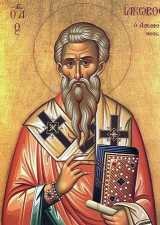
James, brother of JesusThe SBL meeting really begins in earnest on Saturday morning. I was scheduled to present a paper at 9am on Saturday morning in the section entitled “The Letters of James, Peter, and Jude.” It’s chaired by Duane F. Watson and Peter H. Davids, who is a well-known scholar and commentator on the NT (and who blogs at http://phdavids.wordpress.com/). Unfortunately Continue reading

Posted in Announcements | Tagged , , , , , , , | 5 Comments